
How it is calculated
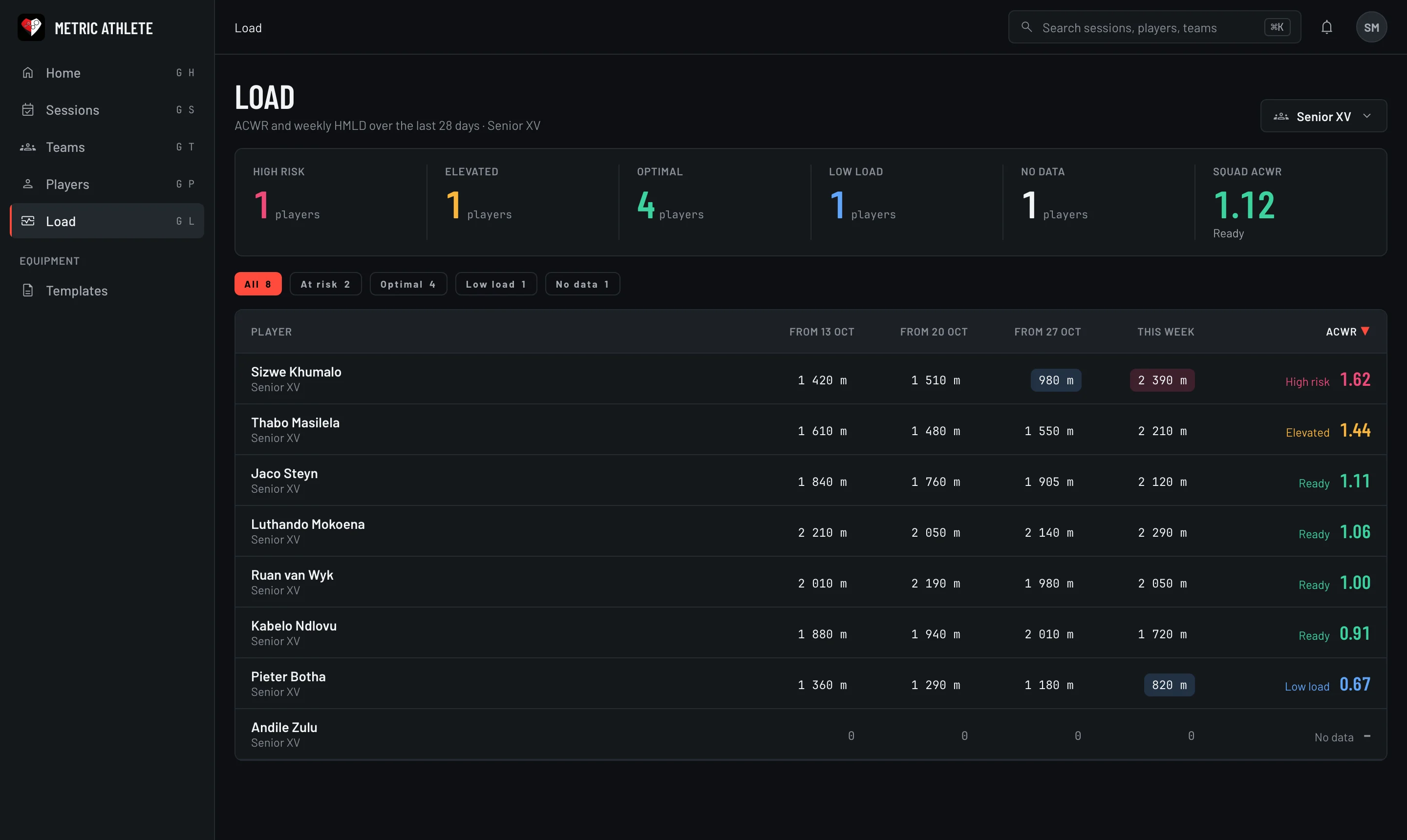
ACWR = acute load (last 7 days) ÷ chronic load (average week over the last 28 days)
- Metric Athlete blends two ratios: 70% from high metabolic load distance and 30% from explosive distance.
- When there is no explosive distance in the 28-day window, the app uses the HMLD ratio alone.
The app flags each player in one of four zones: below 0.8 undertrained, 0.8 to 1.3 the sweet spot, 1.3 to 1.5 caution, and above 1.5 danger.
How to read it
A ratio near 1 means this week looks like the player's recent normal. A high ratio after time off, or a sudden jump in volume, is the pattern to watch.
One player's acute:chronic workload ratio over eight weeks
| Week | Ratio | Zone |
|---|---|---|
| Wk 1 | 0.92 | Sweet spot |
| Wk 2 | 1.04 | Sweet spot |
| Wk 3 | 1.12 | Sweet spot |
| Wk 4 | 0.74 | Undertrained |
| Wk 5 | 1.38 | Caution |
| Wk 6 | 1.58 | Danger |
| Wk 7 | 1.21 | Sweet spot |
| Wk 8 | 1.06 | Sweet spot |
Keep in mind
ACWR needs four weeks of sessions to be meaningful. Early readings for a new player are not reliable.
Where you see it in the app
Questions
Which load does Metric Athlete use for ACWR?
A blend of high metabolic load distance (70%) and explosive distance (30%), so both fast running and stop-start work count.